Is A Pipe Clamp Repair Enough Or Just Temporary?
Free Call · Answered 24/7 · Local Pros Near You
Quick Answer
A clamp over a small, clean pinhole in otherwise sound straight pipe can hold for a long time, but most clamp repairs should be treated as temporary. A clamp cannot restore strength to a split, corroded or frozen section; it only squeezes a seal over the damage. If the pipe around the clamp is ageing, plan a proper cut-out replacement and use the clamp to buy safe time, not to end the story.
Is A Pipe Clamp A Permanent Fix?
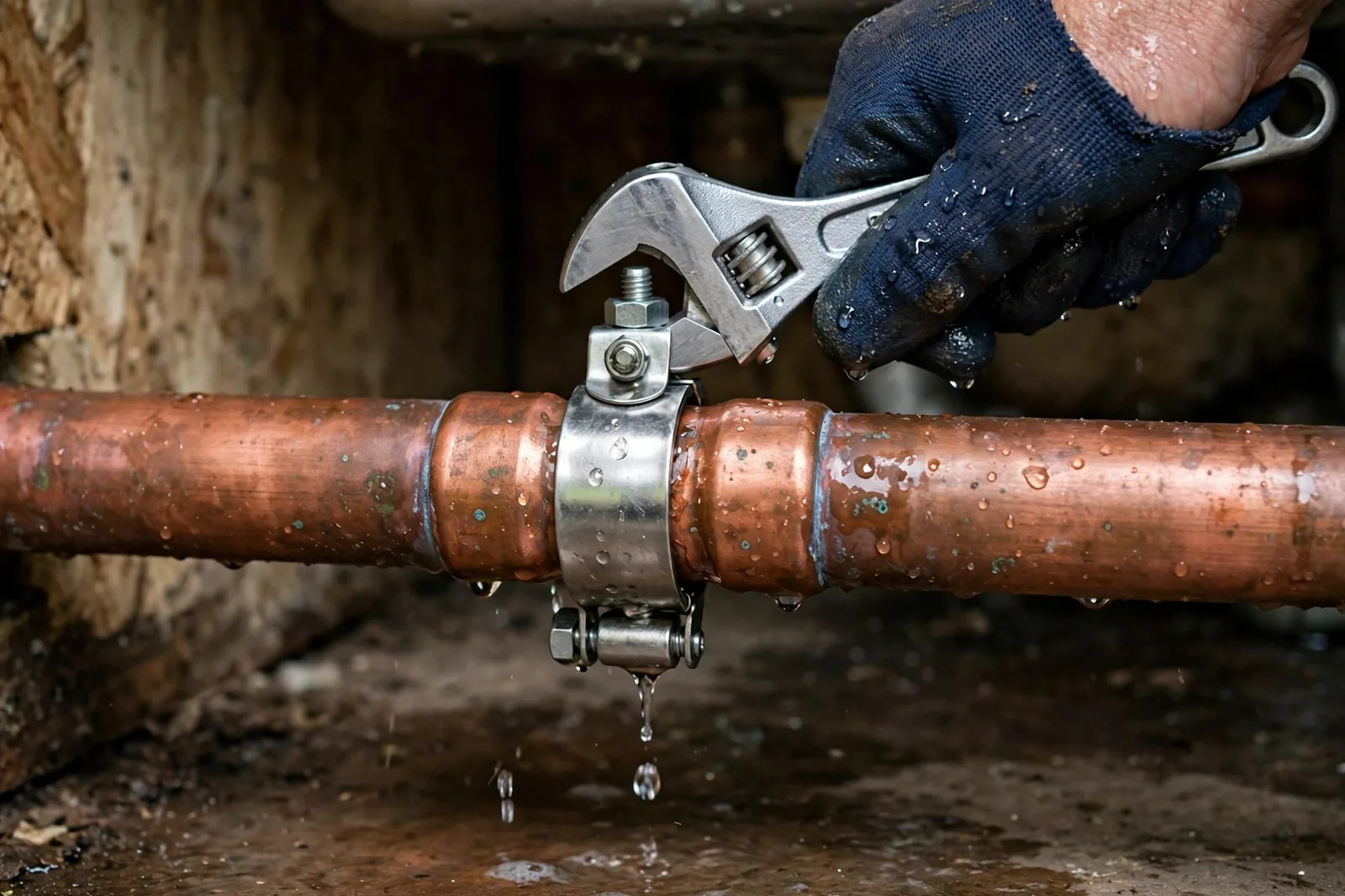
It depends on what it is clamping. A pipe repair clamp, a metal band tightened over a damaged pipe section to seal a leak, works by pressing a rubber seal against the pipe surface. On a small round pinhole in a straight, clean and otherwise strong section, that seal can hold for years. On a lengthwise split, the same clamp is pressing on a section that has already torn, and the tear can extend beyond the band.
The honest rule is that a clamp seals a hole; it does not repair a pipe. The metal underneath keeps whatever weakness it had — thinning, cracking or corrosion — and pressure and temperature cycles keep working on it. Treat any clamp fitted during an emergency as a reprieve with a plan attached, and ask the pro directly whether they would leave it as the final repair in their own home.
Why Do Some Clamps Last For Years Anyway?
Because the underlying pipe was sound. A single pinhole from one corrosion pit in an otherwise thick wall is a local flaw, and sealing it well removes the only problem. Longevity stories almost always involve that pattern: straight run, round hole, clean surface, correct clamp size. The failures come when a clamp is asked to hold a split, a joint or a section that is thin across a wide area.
When Is A Coupling Repair Enough?
A coupling repair is different from a clamp, and the difference matters. In a coupling repair the damaged section is cut out completely and a new piece of pipe is joined in with connectors on both ends. Nothing damaged stays in the line, so a coupling repair on a local failure is a genuine, lasting repair, provided the pipe on both sides is sound enough to join to.
That proviso is where judgement comes in. If the cut ends show clean, full-thickness walls, the new section has something solid to hold. If the ends are thin, flaky or oval, the pro should keep cutting back to sound metal or discuss a larger replacement. Our guide to when a burst means repiping sets out the signs that the whole line, not one section, is at the end of its life.
Pipe Frozen Or Burst Right Now? One Free Call Connects You With A Local Pro.
Call NowWhich Small Failures Suit A Clamp Or Sleeve?
The suitable list is short and specific: a single pinhole, a small round puncture from a nail or screw, or a minor weep at a smooth straight section, all in pipe that is otherwise thick and clean. The clamp must match the pipe's outside diameter and sit on a round, smooth surface so its seal presses evenly all the way around.
Material shapes the answer. Copper pipe, the metal pipe used in many Idaho homes, gives a clamp a firm, smooth seat. CPVC pipe, a rigid plastic rated for hot and cold supply that turns brittle with age and cold, is a poor candidate: tightening a band on brittle plastic can extend a crack. PEX pipe, a flexible plastic pipe that can expand slightly, is normally repaired by cutting and crimping a new section rather than clamping the flexing tube.
Where Does Epoxy Putty Fit In?
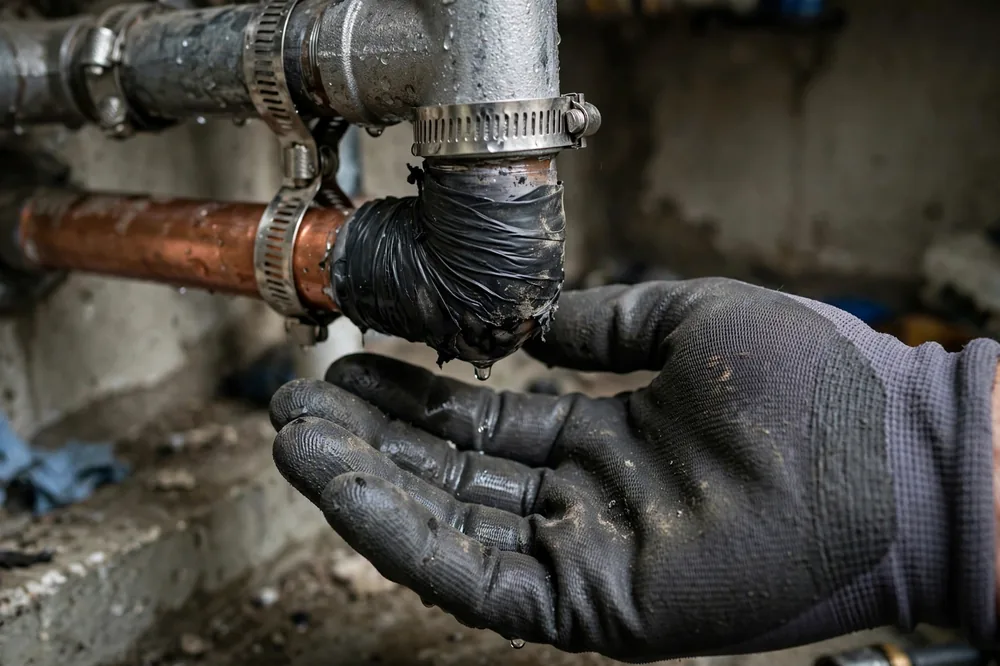
Epoxy putty, a hand-mixed sealing compound used as a short-term patch on a small leak, sits firmly in the temporary category. It can slow a drip while you wait for a pro, on a dry, cleaned surface with the pressure off, but it is a plug, not a repair. Note where you used it and tell the pro; putty over a split tells its own story about what the pipe underneath has already suffered.
Which Failures Should Never Be Clamped?
Never rely on a clamp for a lengthwise freeze split, a burst at a fitting, a leak at a joint, or any section you can dent, flake or flex by hand. A failed fitting, a joint, elbow or connector that cracks or separates, needs replacement, because a band cannot restore a connector. Likewise, ice expansion pressure, the force created when water freezes and expands inside a closed pipe, splits pipe along its length, and that torn section must come out.
Widespread corrosion is the other disqualifier. Pipe corrosion, the gradual wearing away of a pipe wall until it fails, rarely confines itself to the one spot that leaked first. Galvanized steel pipe, an older zinc-coated steel pipe that corrodes from the inside over time, often shows several thin areas along a run. Around burst pipe help in Shelley, pros who find that pattern recommend replacing the run rather than decorating it with clamps.
How Long Can A Temporary Clamp Stay On?
Treat a temporary clamp as a bridge to a scheduled repair, measured in days or a few weeks, not seasons. While it is on, the area should stay visible or at least reachable, and you should check it whenever you pass: fresh dampness, a mineral crust or a slow drip at the band's edge all mean the seal is losing and the planned repair just became urgent.
Do not bury a temporary clamp inside a closed wall and forget it. If a wall must be closed before the full repair, say so and agree a date for the permanent work, and keep dated photos of the clamp in place. In colder northern towns, homeowners asking about burst pipe help in Sandpoint hear the same caution: a clamp that survives summer can still fail on the first hard freeze, when the pipe around it is stressed again.
What Should You Monitor After A Clamp Goes On?
Watch three things: the water meter, the utility meter that records water use, with all taps off; the surface below the clamp for new damp; and the pressure at nearby taps. A meter that creeps, a cabinet base that stays damp or pressure that fades all point to a seal that is passing water. Catching that early keeps a known, small problem from quietly soaking a wall for weeks.
How Does A Pro Decide Between Clamp And Replacement?
The decision follows the pipe's condition, not the clock. A pro cuts nothing at first: they clean the damaged area, look at the shape of the failure, check wall thickness around it, and read the rest of the run for corrosion, bulges and earlier repairs. A pressure test, filling a line at a set pressure and watching for a drop, after a clamp is fitted shows whether the seal truly holds at full house pressure.
Access plays a part too. A clamp may be the sensible first step in a tight crawl space, the shallow space under a home where supply pipes often run unheated, to restore water safely tonight, with replacement scheduled in daylight. What separates a careful pro from a careless one is not the clamp itself; it is whether a clear plan for the permanent repair leaves with it. For sudden failures, the statewide emergency hub lists who does what, in what order.
What Should Happen At The Permanent Repair?
The permanent repair removes the damaged section entirely. A pipe cutter, a tool that cuts a clean section of pipe so a damaged part can be removed, takes out the split or thinned piece with a margin into sound pipe, and new pipe is joined with a brass fitting, a corrosion-resistant metal connector used to join sections, or the connector matched to your material. The line is then pressure tested before any wall or floor is closed.
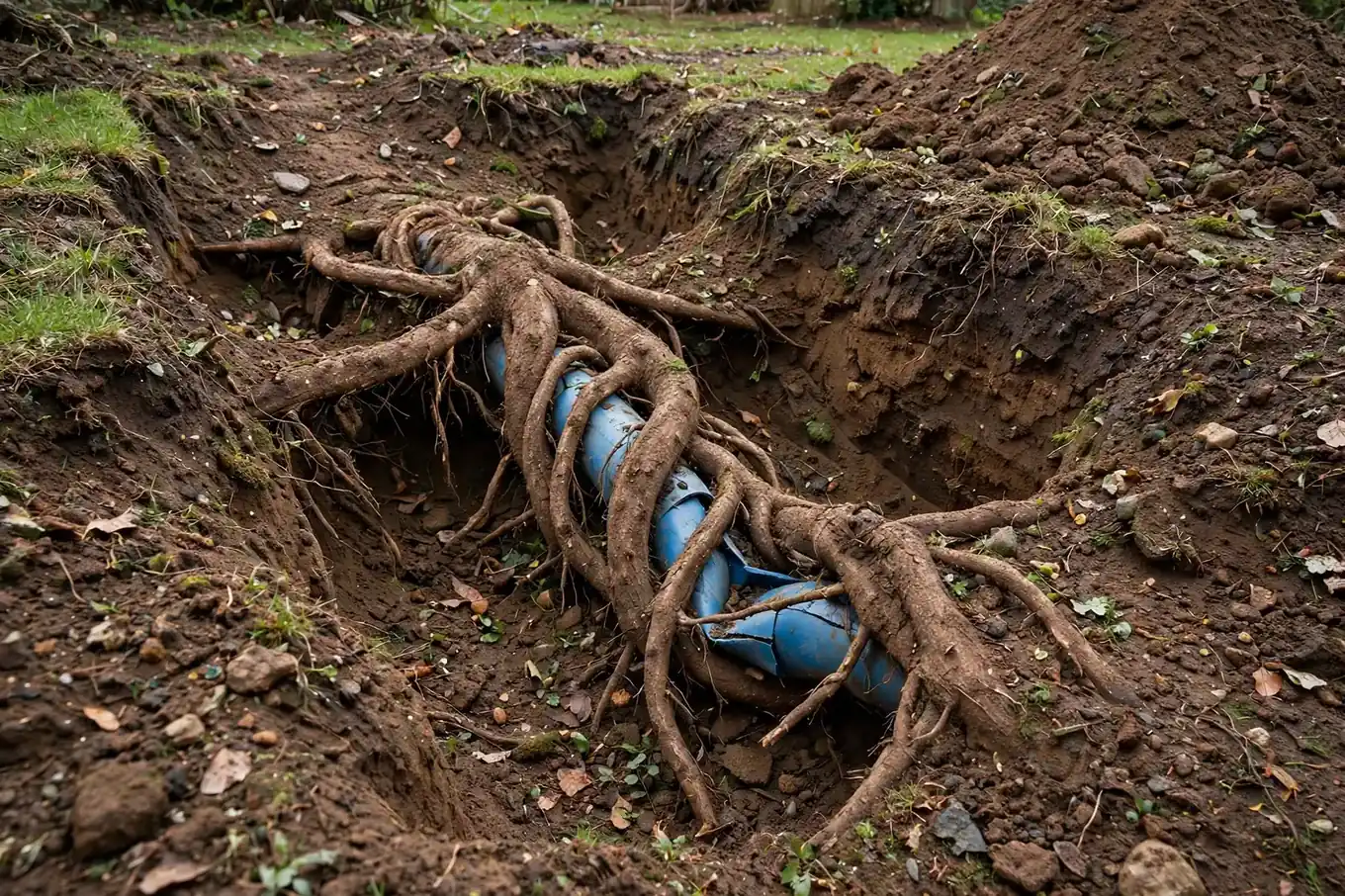
The same visit should answer why the pipe failed. If high water pressure, supply pressure above what home plumbing is designed for, contributed, or if shifting soil, ground movement that bends buried lines, stressed an underground section like those in our tree roots and shifting soil guide, fixing only the hole leaves the cause in place. To arrange a proper repair, call Idaho Burst Pipe Pros on (800) 555-0100; the free service connects you with independent local pros, including for burst pipe help in Saint Anthony, with arrivals typically in 30 to 60 minutes.
Should You Keep The Removed Section?
Yes, at least until any insurance questions are settled. The cut-out piece shows the split, the wall thickness and the corrosion pattern better than any description, and it helps a second pro judge the rest of the line honestly. Photograph it next to a ruler, keep it dry, and note the date and location it came from. Small evidence like this settles arguments about cause months later.
Frequently Asked Questions
Straight answers, no fine print. If your question is not here, one free call gets you a local pro who can check your exact problem.
Still Have Questions? Call Free
Answered 24/7 — a local pro can arrive in 30–60 minutes.
Call Now — (800) 555-0100Sometimes, in a narrow set of cases: a small round pinhole or puncture in a straight section of pipe that is otherwise thick, clean and round. There, a correctly sized clamp can seal the only flaw the pipe has. On a split, a joint or a corroded section, a clamp is temporary by nature, because it seals the surface while the weakness underneath remains. Ask which case yours is, and why.
A coupling repair is enough when the damaged section is fully cut out, the new piece is joined to sound pipe on both sides, and the line then holds a pressure test. Unlike a clamp, nothing damaged stays in service, so this is a true repair for a local failure. It stops being enough when the pipe beyond the cut ends is also thin or cracked, which is why a careful pro inspects the cut ends before joining.
A hardware-store clamp on an accessible, straight section can be a reasonable stopgap while you wait for a pro, with the water off and the surface cleaned and dried first. Fit the size matched to your pipe and tighten evenly. Be honest about its role, though: it buys time and limits damage, it does not prove the pipe is sound. If the failure is a split, a joint or anything inside a wall, leave it to a pro.
Usually because the pipe kept changing under it. Corrosion continued to thin the wall, temperature cycles worked the seal, or the original split extended a little beyond the band and finally passed its edge. A clamp fitted over brittle or oval pipe can also lose its even pressure as the surface crumbles. A failed clamp is information: the section was weaker than a surface seal could manage, and cut-out replacement is the next step.
No; it fills a different, smaller role. Putty can plug a tiny weep on a cleaned, dry surface with the pressure off, which makes it handy for slowing a drip during the wait for help. It bonds to the surface rather than gripping the pipe, so pressure and movement defeat it sooner than a clamp. Treat both as temporary, and treat putty as the more temporary of the two. Neither replaces cutting out damaged pipe.
Only as a short emergency measure, and often not even then. Freeze splits run lengthwise, so the torn edges move under pressure and the damage may extend well past what you can see; a band may slow the leak without truly sealing it. The split section needs to come out. If a clamp is used to control water while you wait, keep the main valve ready to close and do not close the wall until the real repair is done.
The saving depends on access, pipe material, how much pipe must be cut out and whether walls or floors need opening and repair. A clamp is cheaper today because it is less work; the honest comparison includes the cost of a second failure if the section was weak. Ask for both prices in writing: clamp as a stopgap, and cut-out replacement as the finish. On sound pipe the numbers may be close; on tired pipe the replacement is usually the saving.
Inspectors commonly flag clamp repairs and ask whether they are temporary or the final fix, and buyers often ask the same. Keeping the pro's invoice, dated photos and any later replacement paperwork answers those questions cleanly. If you sell with a clamp in place, disclose what it covers and what the pro found. A documented stopgap is a small conversation; an undocumented one discovered later becomes a large one about trust.
Then a clamp is the wrong tool. A band cannot restore a cracked elbow, a separated threaded joint or a failed solder seam, and tightening one nearby can distort the joint further. The fitting itself must be cut out and replaced, and the new joint pressure tested. Joint leaks also deserve a look at the neighbours, because joints on the same run shared the same pressure, cold and age that produced this failure.
Call Idaho Burst Pipe Pros on (800) 555-0100. The free service connects you with independent local pros, answered 24/7, with arrivals typically in 30 to 60 minutes. Show the pro any clamp or putty already in place and say how long it has been there. While you wait for a leaking line, close the main water shutoff valve, the main valve that stops all water entering the home, and take dated photos of the damage for your records.
Reviewed By Hamza
Lead Water Damage Restoration & Structural Drying Specialist
Hamza is an emergency water restoration specialist with deep expertise in burst pipe mitigation, freeze damage remediation, and industrial structural drying across freezing northern climates. He focuses on rapid moisture extraction, thermal imaging diagnostics, and comprehensive subfloor restoration to protect homes from mold and structural deterioration.
Updated October 27, 2026
Need Burst Pipe Help In Idaho?
One free call connects you with a local pro — answered 24/7, and a pro can arrive in 30–60 minutes.
Call Now — (800) 555-0100Free Call · Answered 24/7 · Local Pros Near You